Henry B. Walthall: Bibliography--Contemporary Articles
A Tribute Page to the Silent Film Star
Contemporary Periodicals (by year)
Reel Life, March 28, 1914. Includes a photoplay on the
film The Floor Above with a picture of Walthall (page 6).
Also includes two pics of Walthall in The Mysterious Shot
(both on page 7) and another from The Floor Above (page 11).
Motion Picture Magazine, April 1914, pp. 114-15. Walthall is
featured in
"Chats With The Players," which doesn't offer a whole lot of "chatting."
The article describes Walthall's hectic, around-the-clock schedule and
his work in the film Gangsters of New York.
Willis, Richard, "David W. Griffith--Genius," Movie Pictorial,
September 12, 1914. I found this article on the Internet. Willis
mentions
that Walthall was ill during the filming of The Clansman
(this article was written before the release of Birth of a Nation
) and states that Walthall had to be operated upon. No specifics
on the illness.
Motion Picture Magazine, December 1914. Walthall is included
in the Gallery of Picture Players (pg. 13) with a short bio
on page 120 that has another nice pic.
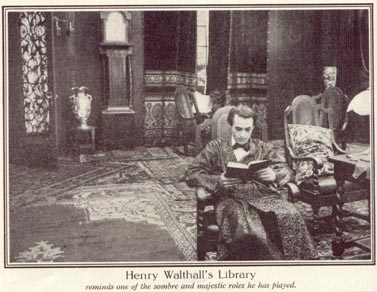
Photoplay Magazine, July 1915. Walthall is among the gallery photos on page 15 and there is also a unique shot of him
in his library on page 70 [see above photo].
Ames, Hector, "Walthall and the Man Who Failed," Motion Picture
Magazine, April 1915, pp. 138-40. Henry explains how "a man can
never be anything but what he is fated to be, tho [sic]
he spend his life being something else." Henry, of course, is fated to
be an actor, though he fails at first and even works as a super in
a theatrical company. He eventually finds his niche on the big screen
(a vehicle by which to display one's acting talents seen as less
dignified at the time). Has a common full-page photo.
The Ladies'
World, September 1915, pg. 34. 4 1/2" x 7 1/4"
ad announcing that Essanay now has the "greatest
actor in photo-play" (who could that be?). Includes
nice photo.
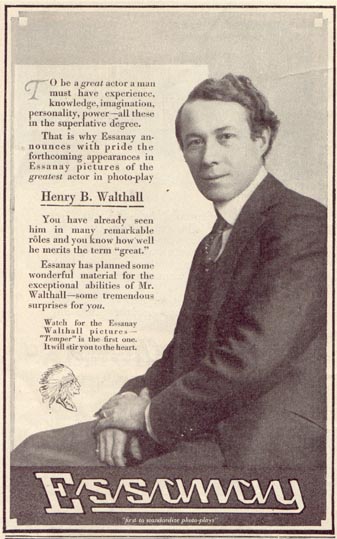
Essanay ad
for "the greatest actor in photo-play."
Motion Picture Classic, February 1916. No Walthall article in this issue but it does offer four photos. The first and best one is a large photo on page 35 that is part of the article "The Character Man of the Movies." Walthall looks to be in a drunken stupor in a scene from The Outer Edge. The second photo (very dark in my copy) is Walthall on horseback with Lillian Gish in The Mountain Rat in an article on the equestrian skills of several actresses (pg. 43). Another nice large photo is on page 48 showing Walthall as Edgar Allan Poe in The Raven reaching out over a lake as he sits next to Warda Howard. It shows their reflection in the lake. Finally, on page 46 is a smaller version of The Birth of a Nation photo that would also be used in the 1921 article "He Isn't The Little Colonel Anymore" (see below) and is used as the top of "The D.W. Griffith Years" page of this website with the caption "The Confederacy's Finest." What is the most interesting about this page is a paragraph describing how he and Mrs. Walthall took a former actor who had become a "hopeless dope-fiend" into their home until he was "cured." The "Mrs." was obviously the first Mrs. Walthall about whom I have read nothing. I had assumed they were separated by the time he went into films. The paragraph does not indicate when this act of kindness took place, however.
Grau, Robert, "The Twenty Greatest In Filmdom," Motion Picture
Magazine, May 1916, pp. 109-11, 181. Walthall is #19 with the
comment "of whom Shakespeare would have said, 'This is a picture
actor.'" The issue also includes a Screen Masterpieces contest where
readers voted for their favorite performances. Walthall came in second
(by 160 votes) for his role in Birth of a Nation. He is also
listed 4 more times: #7 for Avenging Conscience, #18 for
Ghosts, #57 for The Raven, and #83 for Temper
(pp. 179-80).
Willis, Richard, "The Edwin Booth of the Screen," Motion Picture
Classic, June 1916, pp. 55-56. Gushing article with nothing but
praise for Walthall as a humble, "sympathetic and emotional character."
Has five pics, four from Avenging Conscience which, in Willis's
opinion, showcased "Wally"'s finest performance. The first pic is
an enlarged version of the photo used in the short bio in the
Dec. 1914 Motion Picture Magazine above (a nice one, by the way).
Due to the attention given to Avenging Conscience with no
mention of Birth of a Nation, I suspect the article may have
been written in 1914, but I am not certain.
Williamson, Edwin, "The Early Days of Henry B. Walthall,"
Picture-Play Magazine, August 1916, pp. 83-89. A "boyhood
chum" recalls some neat little tidbits of Henry's youth including pics
of his hometown haunts (there is one pic of him at age 4 that is rather
humorous). Some of Henry's many talents include horseback riding,
singing, and playing the mandolin.
Radnor, Leona, "The Sting of Victory," Moving Picture Stories, August 18, 1916,
pp. 6-9. The film Sting of Victory, where Walthall plays two
characters, David and Walker Whiting--brothers who serve on opposite sides
of the American Civil War, is told in story form. It offers three
nice photos of Walthall.
Remont, Fritzi, "What Their Handwriting Portrays," Motion Picture
Magazine, March 1917, pp. 43-47. An analysis of Walthall's
handwriting is on page 46. This issue also has a photo of Henry
playing golf with E. H. Calvert at a Chicago Country Club on page 36.
Cohn, Alfred A., "The Reformation of 'Wally,'" Photoplay,
December 1917, pp. 31-33. Describes how Walthall is moving away from
the roles of drunkards and psychopaths in favor of more happy characters.
Four wonderful photos accompany this article including a sweet full-page
photo of Henry and future wife Mary Charleson going over a script together.
A note on the cover of this magazine is just as interesting: by merely putting
a 1 cent stamp on the notice, it would be "placed in the hands of our
soldiers and sailors at the front."
Walraven, Hesser J., "A Man of Destiny," Moving Picture Stories,
May 31, 1918, p. 26. A rather sycophantic article on how Walthall
rose from the obscurity of the southern plantation to heed the call of
the articulate drama. Walraven (great name for a reporter on Walthall!) does note that Walthall began his own
independent film organization, Henry B. Walthall, Inc., under the
direction of Paralta Plays. Has one nice picture.
McGaffey, Kenneth, "The New Walthall," Motion Picture, May 1919,
pp.32-34, 101. Long Lane's Turning-era article that explains
Mrs. Walthall's role in helping Henry find his niche in his acting
career (taking over "business complications" and other unpleasantness).
Mentions Walthall's dislike of ministers (because mother Walthall once
sent a goose the young Henry shot to the local clergyman) and
Henry's younger brother Junius who was in the hospital in France due
to shrapnel wounds he suffered in the Great War (he survived and
earned the purple heart).
Includes five photos of Walthall including one with his wife.
Gaddis, Pearl, "He Isn't The Little Colonel Anymore," Motion Picture
Magazine, September 1921, pp. 38-9, 88. A very nice article on
how Walthall wants to move beyond the Little Col. image.
Includes a few quotes from the man himself (always nice to read in
these articles). Gaddis
describes Walthall as having a keen sense of humor and a well-balanced,
wholesome life with his wife (curiously, no mention of his daughter).
No juicy rumors here (oh well). This article also includes 5 awesome
pics!
Wright, J. C., "Answering the Call," Classic, November 1922,
pp. 66, 81. Wright conducts an interview with Walthall and includes
a few quotes. Walthall discusses his need to heed the call of the
"footlights" (theatre) as well as his love of nature and fishing,
"I well remember when a sixteen pound muskalonge nearly won...".
Article includes two beautiful photos (see the biography page for one
of them).
Motion Picture Magazine, "Gallery of Players," November, 1922,
p. 19. Gorgeous full-page photo. Mentions Walthall will have the
lead in Rupert Hughe's Gimme.
Screenland, "The Pathos of Henry B. Walthall,"
September 1924. I only have the last part of this
extremely rare article. The part I have includes the
end of a story where Henry told his director
(probably D.W. Griffith) basically that he would come
to work when he felt like it. This conversation took place
after Walthall was admonished for arriving late.
The rest of the article is the common description
of how Walthall's career took a nosedive following
The Birth of a Nation, his poor health, etc.
Griffith, D.W. Mrs., When the Movies Were Young, New York:
Benjamin Blom, 1925. Includes a few first hand observations on 'Wally' in
the Biograph company.
Donnell, Dorothy, "I Remember When," Motion Picture
Classic, November 1925, pp. 40-1, 71. "Henry Walthall
compares the old days with the films of 1925."
Includes two nice, large photos and a common
Birth of a Nation shot. In this interview,
Walthall chain smokes and describes how the pictures
were made in the "good ol' days," which, was actually
a mere 10 to 16 years earlier. "We studied our parts
before we tried to play them, we spent more time
rehearsing than we did actually making the film. We had no music
to help us portray emotion when I began to play in the
movies--we had to really act [italics are the
author's]...they would hold a stop-watch on us while
we rehearsed it. Now they cover miles of celluloid doing
the same scene." Walthall laments on how much emphasis
actors place on money and makes an interesting comment:
"the audiences have improved--it takes a better man to
pay fifty cents to see a picture than to pay five."
In the final line he says, "Oh yes'm, everything is better,
everything--except just the pictures..." Another intriguing
tidbit in this issue is the results to a readers' poll for the
most popular picture on page 53. The Birth of a Nation, a ten-year
old film at that time, rated #1, 20 points ahead of Monsieur Beaucaire
(1924) which starred the iconic Latin lover Rudolph Valentino.
Pictures, July 1926, p. 4. Has small photo of Walthall in
The Road to Mandalay with the note "Actors may come and actors
may go but there will never be another figure on the screen with more
drama than Henry B. Walthal l."
Benthall, Dwinelle, "Poverty Row," Motion Picture,
December 1926, pp. 26-7, 113-14.
Walthall is mentioned as a member of Hollywood's "poverty row"
(former stars who have fallen in status) as one who is "climbing up
again." Includes one small pic.
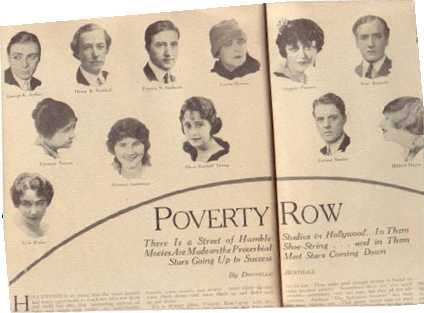
Remember "Where's Waldo?"? Well, let's play
"Where's Walthall?".
If you cannot find him, then this
is the worst tribute site on the web.
Wilson, B. F., "The Evolution of the Movie Hero," Motion Picture,
December 1926, pp. 56-7. In the same magazine as the above article
is a short gallery illustrating "Six Stages Which Depict the Changing
Styles in the Gentlemen of the Celluloid." Walthall is the third
stage: "D. W. Griffith was responsible for a change in style when he
produced "The Birth of a Nation." For Henry B. Walthall as the
Little Colonel proved that another type of man also had attraction."
No explanation on what the author meant by "another type of man"
("little"?). The article includes a commonly used "Little Colonel" pic.
"Griffith To Greet H. B. Walthall," The Los Angeles Record, March 19, 1928, pg. 4.
A column describes the upcoming premiere of the play Speakeasy at the Grand Avenue Playhouse scheduled for that night. D. W. Griffith would act as master of
ceremonies to welcome Walthall in his first theatre performance in eight years.
Many film people made reservations for the event including Pola Negri, Alan Hale,
Lon Chaney, Corrine Griffith, Greta Garbo, Mary Philbin, Edmond Lowe, and Charles
Chaplin. The "entire theatre" was decorated to honor Walthall "with the front of
the house bedecked uniquely to give typical atmosphere." Mary Charleson Walthall,
who also had a part in the play, is pictured.
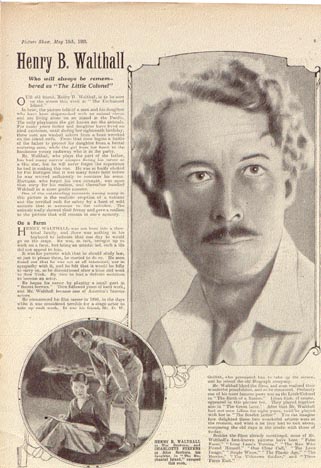
Article in Picture Show
May 19, 1928, pg. 9.
Describes the upcoming film Enchanted Island
Picture Show, May 19, 1928,
pg. 9. This issue of a UK publication has a one-page
mini bio of Walthall with a description of the upcoming
film The Enchanted Island. This is the paragraph
that caught my eye: "Mr. Walthall, who plays the part of
the father, has had many narrow escapes in his career
as a film star, but he will never forget the experience
he had in making this one. He was so badly choked by
Pat Hartigan that it was many hours later before he was
revived sufficiently to continue his scene. Hartigan, who
forgot his own strength, was more than sorry for his
realism, and thereafter handled Walthall in a more
gentle manner." Sexy photo accompanies the article
(see above).
Hall, Gladys, "The Little Colonel Carries On," Motion Picture,
January 1929, pp. 42, 93, 95. Written by a Walthall fan from back in
the day who gushed, "That's my man" (or something along those lines),
whenever she saw him on the screen or pictured in a magazine (now who'd
gush over a magazine photo of Henry B. Walthall?...Oh, yeah, that's right).
Growing up to be a reporter on the movie stars, Hall gets a call from the
man himself to go out to lunch. The story describes his beginnings as the
"black sheep" of his family due to being the only one bitten by the Broadway
bug, his early works in film and what happened to the stars of yesteryear.
According to Walthall in, as Hall observes, "that sad, off-hand voice of his," "the ones who
have remained are the ones who have kept their heads. Their balance. They haven't
grown impossible egos, thought they were of supreme importance, become overbearing,
cold to others..." He also talked about the need to change the type of one's work
as one ages. The most eye-opening revelation in this interview was his
answer to Hall's question "Would you do it [be an actor] all over again if you could?"
Walthall replied, "No..." There is a definite melancholy undertone to the article.
It offers three rare photos including one from the film
The Little Colonel with him, according to the caption, "surrendering
his heart to Ethel Stone" which is rather sweet (the photo, not the sappy caption).
Hayden, Kathlyn, "Killed By Success," Picture Show, June 8, 1929,
p. 18. There is something about 1929 that brought on the depressing Walthall
stories (and the stock market hadn't even crashed yet). The above article by Hall
described Walthall's sad laughter and voice and his revelation that he would not
be an actor if he had it all to do over. Topping that, this Hayden interview of the same year
is the most bitter I've read. Walthall explains
how he has "been trying to live down that picture [Birth of a Nation]
ever since it was made." Of his famous role, he stated "It's beautiful,
but I'm sick of it." The author explains that, after reading a review
claiming he was receiving "shabby treatment" in the film industry, Walthall
was bent on dropping film work and returning to theatre. Walthall also
lamented on why he did not
enjoy much success in theatre: "Can you imagine what it is to rehearse
a part and know that you are doing well, and then to have someone say:
'Your work is all that could be desired, and we would keep you in this--
if you were only an inch or two taller!'"
Boy's Cinema, May 17, 1930, pp. 19-25. The film "In Old California"
is put in story form in this issue. Henry received top billing in the
film, but only has one photo in this magazine (on page 23).
Kingsley, Grace, "Reminiscences of Henry Walthall," The New Movie Magazine,
August 1931, pp. 76-77, 101-3. "The beloved 'Little Colonel' relates
his recollections of the glamorous days of film making." Includes two
photos including the gorgeous one at the end of the Biography page.
Parton, Lemuel F. "Fade-outs," Vanity Fair, July 1932, pp. 18-19, 56,
60). Just one sentence on Henry Walthall but it does offer two photos, the earlier
photo is used in Walthall's bio in the Hollywood Forever directory and the
later one I have not seen anywhere else.
Rankin, Ruth, "The Little Colonel Marches Back," Photoplay,
June 1934, pp. 70, 95-7. Interesting article on Walthall being
"rediscovered" by the talkies which was written after the success of
Viva Villa. Also discusses Walthall's illness before the
filming of Birth of a Nation (again, no specifics). Includes
3 photos including a rare shot from Men in White.
Hill, Gertrude, "Henry B. Walthall: A Gentleman of Hollywood,"
Silver Screen, October 1934, pp. 26-7. Interesting interview
conducted by a visitor to Henry's hunting lodge in California's
High Sierras. Walthall talked about his role in Viva Villa!
(a role in which he "felt uplifted"), his preference to play villains
("There is sauce to a villain"), why he never wanted to play
Hamlet ("I'd rather have more action and less talking"), and the time
he felt greatest (when a girl took him to be younger than he was).
This article is the only account I've read describing Walthall's eyes as
being blue.
Williams, Whitney, "'The Little Colonel' Returns to Glory,"
News Telegram, Dec. 28, 1934, p. 5. A happy Henry describes
the accolades he received since the release of Judge Priest.
Of his role as Rev. Ashby Brand: "Many a year has passed since I played a
part that pleased me so." I learned from this article that one of
Walthall's favorite dishes was corn bread and creamed chicken.
"3-Miljoners-film fran Fox: 'Dantes Inferno,'" Allas Veckotidning
January 5, 1936, pp. 23-22 (the page numbers are strangely reversed).
This Swedish film magazine devotes its centerfold
to coverage of the film Dante's Inferno. It is a beautiful
colorized collage with two photos of Henry.
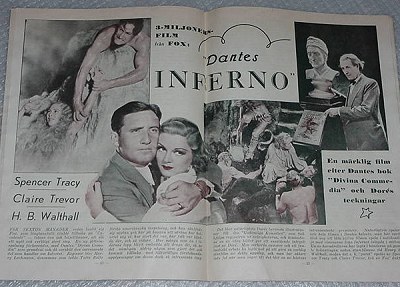
Nice colorized look at Dante's Inferno.
Note: Henry is also pictured,
dressed as Virgil, holding the character
who plunged to his death.
"Artistas Que Desapparecem," Cinearte Rio de Janeiro,
15 de Agosto de 1936, pp. 40-1, 45. Brazilian magazine with
a feature on Walthall. I cannot read a word of it, but it
has the coolest collage of photos, some of which I have
not seen anywhere else. It made an appropriate memorial
feature, but it makes no mention of China Clipper,
and I can't find anything that looks like a reference to his death,
so I am not sure if it was just a coincidence. [Not in this article,
but an interesting note considering this magazine is from South America: Walthall's
daughter Patricia left the rigors of movie life, married and moved to
Buenos Aires. She had two children (son and daughter)].
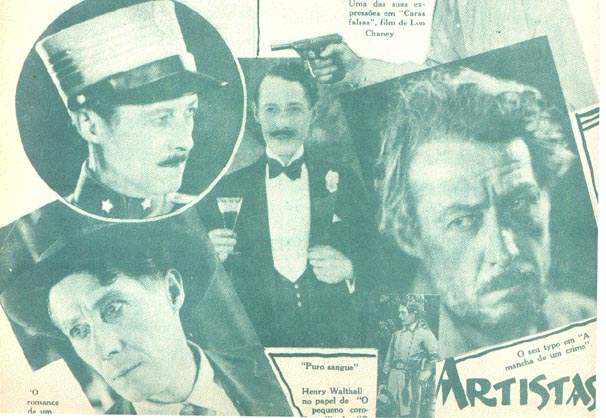
Sample of the montage
of photos in Cinearte magazine
Boy's Cinema, December 19, 1936, pp. 2-12, 25-27. "The Last Outlaw"
is the featured story in this issue. Henry does not sport the cover
but he is in 3 photos. Sadly, by the time this publication hit the stands,
Henry was dead.
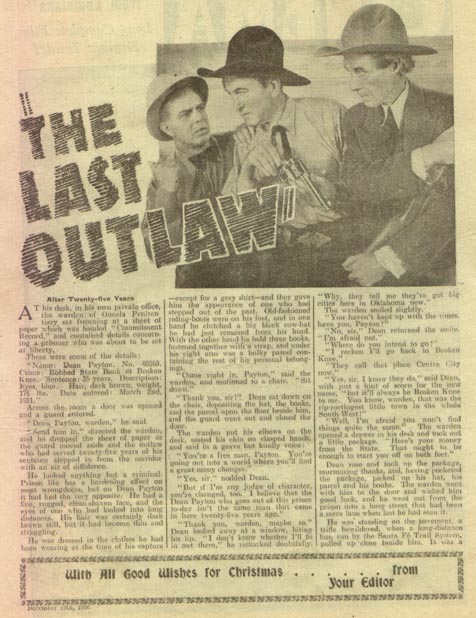
"The Last Outlaw" story
in Boy's Cinema.
Photoplays
Dixon, Thomas Jr., The Clansman, New York: Gossett & Dunlap,
has a copyright date of 1905, but was obviously printed after the
release of Birth of a Nation. Includes one photo of Walthall
(see the home page).
Lewis, Frederick, The Strange Case of Mary Page, New York:
Grosset & Dunlap, 1916. Only has one photo of Walthall as Langdon
in a coat and carrying a top hat (facing page 92). Fortunately, it's a
rather nice one.
Marks, Percy, The Plastic Age, New York: Gossett & Dunlap,
1924. Has only one fuzzy photo of Henry facing page 300. He is
looking at his on-screen son after the football game.
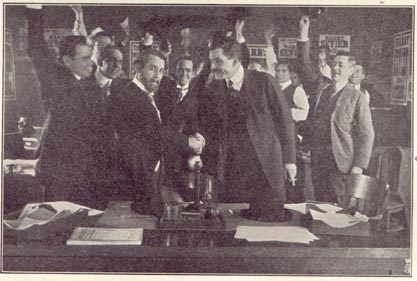
Front photo in
The Long Lane's Turning photoplay.
Rives, Hallie Erminie, The Long Lane's Turning, New York:
Grosset & Dunlap, has a copyright date of 1917, but the film
was released in 1919. Includes 5 photos of Walthall as Harry
Sevier (the front pic, in particular, is quite nice).
Primary Sources (by author)
Bitzer, Billy, Billy Bitzer His Story: The Autobiography of D.W. Griffith's
Master Cameraman, Toronto: Farrar Straus Giroux, 1973. Describes "Wally" as
a fine actor "loved by everyone" whose performances were "ahead of his time." He
also describes him as being perpetually late with "ingratiating and convincing alibis"
that they all looked forward to hearing (pg. 72). He also remarks on Walthall's superb riding abilities (pg. 109).
Brown, Karl, Adventures With D.W. Griffith, New York: Farrar Straus Giroux, 1973.
D.W. Griffith's cameraman recalls being impressed by the "giant" found in "some circus"
who played Holofernes in Judith of Bethulia, later to learn it was the diminutive Walthall (pg. 4). He also explained how a driving scene was filmed for
The Great Love with Walthall at the wheel even though "Henry couldn't drive a
car at all" (pg. 201).
Gish, Lillian with Ann Pinchot, The Movies, Mr. Griffith, and Me, Englewood
Cliffs, NJ: Prentice Hall, 1969. Mentions that "in the 1940s--Mr. Griffith claimed that Walthall's Little Colonel was the greatest male performance in the history of films" (pg. 150). Gish also mentions Walthall's excellent riding skills (pg. 147). This
book also mentions how Walthall needed a bodyguard to get him to work on time which
is included in the "The D.W. Griffith Years" Biography page.
Gish, Lillian, Dorothy and Lillian Gish, New York: Charles Scribner's Sons, 1973.
Describes the scene where she and "Wally" were hoisted up on wires in Home, Sweet Home. Having to film the scene more than once in the hot sun, "Wally fainted" but Lillian had a fun time (pg. 29). Also mentions her meeting with Walthall for The Scarlet Letter, ten years after their last film together The Great Love. She had grown to be "a head taller" and Walthall "had to play our scenes together standing on wooden boxes" (pg. 146).

Free Website Counters